



News
From DNA to Discovery: GCATbio’s End-to-End Synthetic Biology Solutions
Release time:2025-12-25
Synthetic biology has redefined how we engineer biological systems, but the real momentum of the field depends on a single factor: DNA synthesis. This foundational capability dictates how quickly a biological concept can be transformed into a tangible reality.
From large-scale genome engineering to industrial biomanufacturing, progress is no longer just about the "design"—it is about access to high-throughput, high-fidelity, and cost-efficient DNA writing. As the bioeconomy matures, scalable synthesis has shifted from a basic lab tool to the critical infrastructure driving both discovery and commercial application.
This is the mission of GCATbio. By integrating advanced synthesis tech with automated, end-to-end workflows, we enable researchers and industry leaders to realize ambitious biological designs—reliably, efficiently, and at scale.
1. Pioneering Innovation: Developing DNA Synthesis Technologies and Equipment
At the upstream of the synthetic biology value chain, high-throughput DNA synthesis is the bedrock—enabling the scalable, automated gene construction required for modern research and industrial scale-up. To meet the growing demands of genome-scale biology, GCATbio has moved beyond conventional microarrays to a new paradigm: independently addressable microchips.
Powered by fully proprietary mMPS technology, GCATbio's platform utilizes a “identification–sorting–synthesis–pooling” cycle that boosts individual sequence yields into nanomoles—a massive four-to-six order-of-magnitude increase. This innovation streamlines genome assembly into a simple two-step process, removing the need for redundant barcoded primers or extra enzymatic digestion. The result is a system-wide leap in both synthesis quality and operational efficiency.
These breakthroughs are rooted in a forward-thinking approach to synthesis control and chip architecture. By leveraging high-performance materials like silicon carbide and porous aluminum oxide, GCATbio's chips feature 3D microstructures that dramatically expand reaction surface areas. This allows for higher oligonucleotide loading per chip, supporting a reusable, sustainable, and cost-effective model for DNA synthesis at scale.

(mMPS Synthesizer and Synthesis Principle)
2. Building Independent, High-Throighput Platforms for Synthetic Biology
In the midstream of the synthetic biology value chain, the goal is to translate technical capability into practical, scalable workflows. Based on mMPS technology, GCATbio has built a fully integrated, high-throughput platform that spans gene synthesis, library construction, and oligo production across a 10,000 ㎡ facility.
GCATbio system bridges intelligent design software with automated workstations, enabling a seamless, "lights-out" workflow from initial oligo synthesis to long-fragment genome assembly. With an annual capacity exceeding tens of billions of base pairs, the platform moves DNA synthesis beyond laboratory proof-of-concept into the realm of high-precision, industrial-grade output.
Expanding beyond DNA writing, GCATbio has established a modular production ecosystem to support a diverse range of biomolecular needs:
Flexible mg–kg Protein Production: A 7,000 ㎡ GMP-compliant facility utilizing E. coli, yeast, and mammalian cell lines to produce functional biomolecules at scale.
Kg-Scale Biochemical R&D & Pilot Platform: A dedicated 2,000 ㎡ facility focused on the development and small-scale production of fluorescent dyes, dNTPs, phosphoramidites, and nucleotide derivatives.
Together, these platforms form a high-standard, automated foundation for the future of synthetic biology—empowering GCATbio to support cutting-edge research and industrial biomanufacturing with unmatched speed and reliability.

(GCATbio's High-Throught Synthesis/ Protein Production/ Biochemical R&D Platforms)
3. Pushing the Frontiers of Science Through Innovation
At GCATbio, innovation is a continuous journey. With over 59 high-impact publications, 31 key technology, 28 proprietary tools, 103 core technology patents and more than 120 advanced products, our teams turn bold ideas into tangible breakthroughs that advance both science and industry.
3.1 Advancing Synthetic Genomics
As part of the Synthetic Yeast Genome Project (Sc2.0), GCATbio led the de novo design and synthesis of three yeast chromosomes (II, VII, and XIII), contributing over 3 million base pairs—about a quarter of the total genome. This work enabled Mb-scale chromosome assembly and showcased the power of large-scale genome engineering. These synthetic chromosomes serve as versatile platforms for research, enabling new models to explore disease mechanisms, aging biology, and functional genomics.
3.2 Exploring Protein Stability and Disease
In collaboration with the Barcelona Center for Genomic Regulation, GCATbio leveraged our mMPS platform to build a deep-saturation library of over 1.2 million human protein variants—the largest resource of its kind. This library is a catalyst for drug discovery and precision medicine, providing the data needed to understand how protein stability dictates human health and disease.
3.3 Breaking New Ground in DNA Data Storage
GCATbio is also advancing DNA-based information storage, a technology offering unmatched density, durability, and energy efficiency. Covering the full cycle of “encode–write–store–read–use,” GCATbio developed high-density Yin-Yang coding methods, improving data recovery by two orders of magnitude while maintaining seamless integration with upstream and downstream workflows.
Through these initiatives, GCATbio continues to prove that cutting-edge DNA synthesis and molecular engineering are not just theoretical tools—they are the engines of real-world impact.
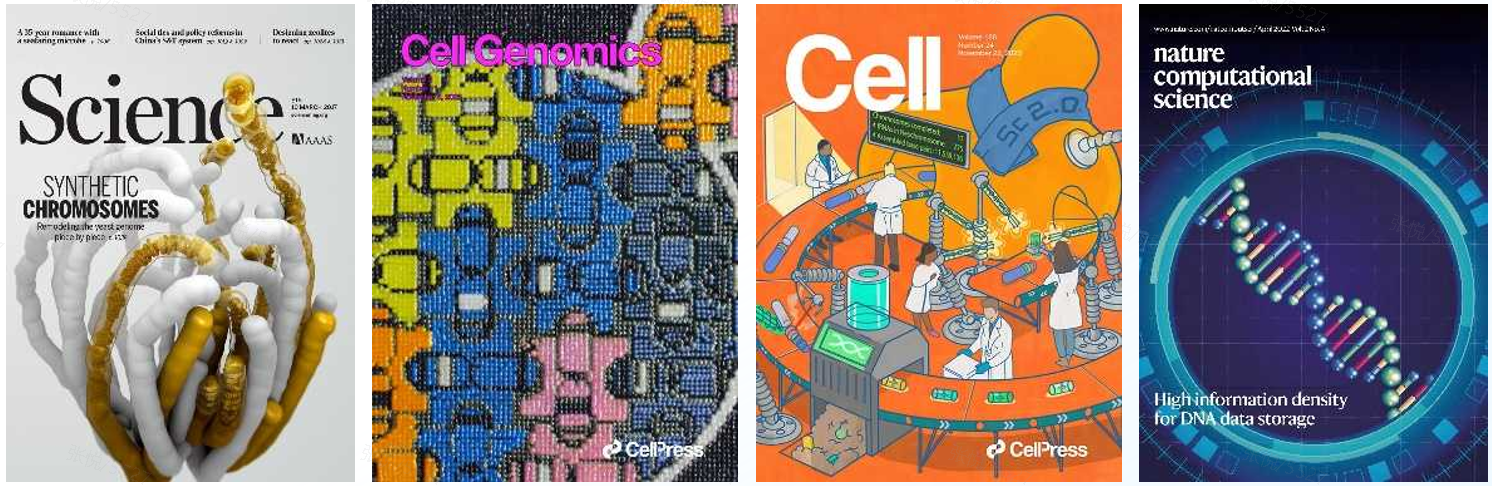
(Science 2017; Cell Genomics 2023; Cell 2023; Nature Comptutational Science 2022)
4. Driving Industrial Applications Through Standard-Setting
At GCATbio, it is believed that turning a breakthrough into a real-world solution requires more than just innovation—it requires uncompromising quality. We have established a comprehensive DNA synthesis standard system that governs the entire product lifecycle. Beyond our internal rigor, GCATbio is an active architect of industry norms, contributing to ISO 20688-2 and 19 other international standards to help define the future of synthetic biology.
By balancing throughput, cost-efficiency, and precision, we have successfully translated our technological foundation into specialized commercial applications:
Diagnostics & Precision Breeding: We provide high-performance probes for clinical IVD, forensic identification, and agricultural genotyping (such as our Soybean 15K panel)—products recognized globally for their consistency and reliability.
Sequencing Infrastructure: With an annual output exceeding 3 million OD units of high-purity primers and adapters, we provide the critical components that keep the global sequencing industry running at peak performance.
Agile Gene Synthesis: From rapid 3kb sequence delivery to the assembly of highly complex genes, we provide the essential building blocks for both industrial strain development and foundational discovery.
By turning synthetic biology tools into system-level solutions across biomedicine, green energy, and DNA data storage, GCATbio is positioning biomanufacturing as the next great engine of global productivity—driving progress for both the life sciences and society at large.
(ISO 20688-2)
5. Comprehensive Synthesis Services to Accelerate Research and Innovation
By integrating advanced automation and rigorous quality control, GCATbio provides four specialized categories of synthesis services designed to scale with the needs of the industry:
Oligo Synthesis: High-purity oligos are produced using advanced HPLC purification, ensuring exceptional batch-to-batch stability and minimal cross-contamination. These tools are optimized for high-throughput sequencing and in vitro diagnostics, supporting over 100 modification types to provide researchers with a versatile toolkit for complex applications.
Gene Synthesis: The proprietary mMPS platform enables the rapid and accurate synthesis of sequences ranging from small constructs to Mbp-scale chromosomes. By combining parallel synthesis with automated assembly and NGS validation, the platform supports large-scale functional studies, providing the reliable infrastructure necessary to accelerate biopharmaceutical discovery.
Variant Libraries: GCATbio delivers tailored variant libraries essential for antibody engineering, enzyme evolution, and drug target screening. By overcoming traditional constraints in sequence length and combinatorial diversity, the company provides the precision required to push the boundaries of functional genomics and gene therapy research.
Capture Panels: Utilizing a proprietary probe design system, GCATbio integrates genomic data with dynamic hybridization thermodynamics and intelligent ranking algorithms. This approach ensures precise targeting of specific loci, overcoming the limitations of conventional methods to provide a high-fidelity foundation for diagnostics and genomic research.
These services offer the flexibility and scale required to accelerate discovery, reduce operational costs, and increase project success rates across the global life sciences landscape.

(GCATbio's Services)
6. Expanding Our Reach: Global Presence and Integrated Solutions
GCATbio delivers end-to-end solutions for the life sciences, integrating expertise in synthetic biology, protein engineering, and nucleic acid chemistry. Headquartered in Changzhou, with R&D hubs in Shenzhen and Hangzhou, GCATbio maintains a business network spanning the Americas, Europe, and Asia-Pacific, ensuring agile responses to research and industrial needs worldwide.
By establishing a strategic ecosystem with over 80 leading universities and global enterprises, GCATbio moves beyond traditional vendor roles to co-create solutions that accelerate research and drive industrial scale-up. Through these alliances, the company does more than deliver products—it shapes the future of synthetic biology and empowers the next generation of scientific discovery.
